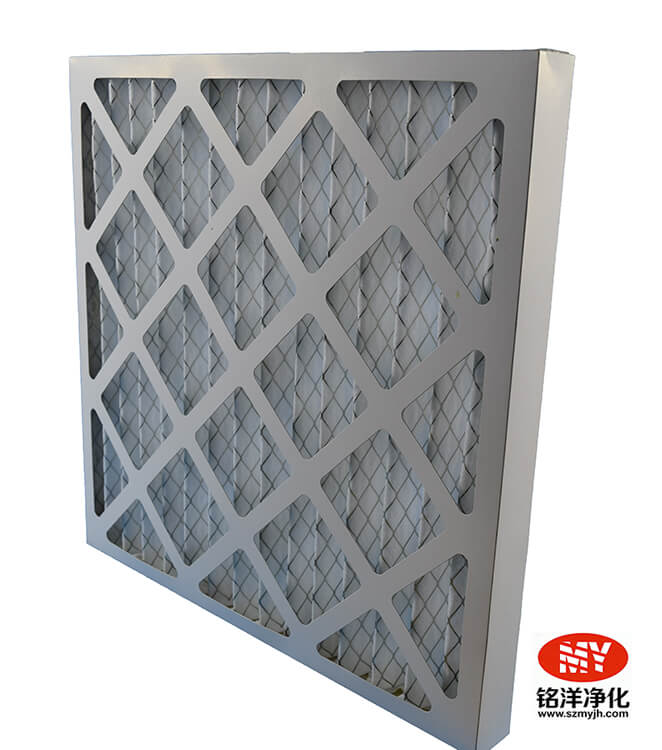
Anyone who has been to large shopping malls knows that they are crowded year-round. Outdoor dust, hair and fabric fibers from customers, and willow catkins and sediment from streets are continuously drawn into the central air conditioning system through fresh air intake. According to domestic public place ventilation hygiene management regulations,Paper Frame Primary Filters for Shopping Mall Central Air ConditioningIt is the first line of defense that cannot be omitted for air conditioning units. Many shopping mall property managers skip filters to save upfront costs, only to face issues like dust accumulation and blockage in cooling coils, soaring electricity bills, unpleasant odors, and failed hygiene inspections. Drawing on years of experience in commercial air conditioning supporting projects, let's discuss the national standard requirements.Paper frame primary filter applicationHard specifications and selection details.
I. National mandatory regulations for installing primary filters in mall air conditioning
Malls are densely populated public places, and their air conditioning ventilation systems are subject to regular spot checks by disease control departments. They must comply with the 'Hygienic Specification for Central Air Conditioning Ventilation Systems in Public Places (WS10013-2023)' and the filter national standard GB/T14295-2019. The specification clearly requires that primary filtration devices must be installed at the fresh air intake of air handling units to intercept large particulate dust and control indoor PM10 and airborne bacteria levels.
Without primary filtration, large debris directly impacts the cooling coil and downstream medium-efficiency filters. Within half a year, heat exchange efficiency drops significantly, forcing the air conditioner to operate at higher power. Not only does indoor air quality deteriorate, but customers with seasonal allergies or respiratory discomfort increase. During special hygiene inspections, the store may be ordered to rectify or shut down. The industry-standard configuration logic is to use primary filters upfront to intercept large dust, combined with medium filters for finer purification, ensuring uniform and clean air supply across all floors of the mall.
II. Core technical indicators of paper frame primary filters suitable for mall environments
Shopping mall air conditioners typically run continuously for over ten hours a day, and the machine room environment is often humid. The most commonly used filters on the market are G3 and G4 grade paper frame primary filters, which are also the most common models for commercial applications.
First, filtration efficiency: G4 filters achieve a weight arrestance efficiency of ≥90% for 5μm dust, effectively capturing hair, debris, and sand without causing excessive airflow resistance due to overly dense filter media, which would strain the air conditioning system. Second, airflow resistance: qualified products have low initial resistance, and pleated filter fabric increases dust-holding capacity. Higher dust-holding capacity extends replacement intervals; most malls only need replacement every 6 to 10 months, reducing labor costs for frequent shutdowns and filter changes.
Third, material requirements: malls are prone to condensation and moisture in mechanical rooms. It is preferable to use impregnated moisture-proof hard paper frames that are not easily softened or deformed by moisture. The filter fabric should be paired with an inner protective mesh to prevent fiber shedding and contamination of the air ducts. Standard sizes of 595x595mm are readily available in stock. For older malls with non-standard air handler dimensions, custom non-standard sizes can be cut as needed.
III. Practical value of paper frame primary filters for malls
Installing compliant paper frame primary filters offers the most direct benefit of protecting core air conditioning components. Less dust accumulation on coils ensures stable heat exchange, and fans do not need to operate under overload, resulting in noticeable monthly energy savings for the entire mall. Additionally, indoor dust and airborne bacteria are controlled, making it easier to keep store shelves clean and improving the shopping environment for customers. The mall can easily pass the annual air conditioning hygiene inspection by the disease control department.
IV. Mingyang Purification's deep involvement in mall air conditioning filter supporting
Relying on 18 years of purification production experience and ISO system certification, Mingyang Purification is equipped with automated production lines and supplies in bulk year-round to major shopping centers and chain supermarkets.Paper frame primary filter applicationSupporting projects: from standard G3/G4 off-the-shelf filters to custom non-standard sizes, we can handle them all. Standard specifications are well-stocked for fast delivery. Free assistance in filter selection based on on-site airflow and machine room conditions, solving the difficulty of finding filters for old shopping mall air conditioning retrofits.
Conclusion
Considering comprehensive hygiene standards and later maintenance costs,Paper Frame Primary Filters for Shopping Mall Central Air ConditioningIt is by no means an optional accessory. Blindly reducing configurations may seem cost-saving, but subsequent electricity bills, maintenance, and rectification costs end up being higher. For new mall installations or air conditioning retrofit filter procurement needs, contact us.Mingyang PurificationCustomize filtration solutions tailored to working conditions.