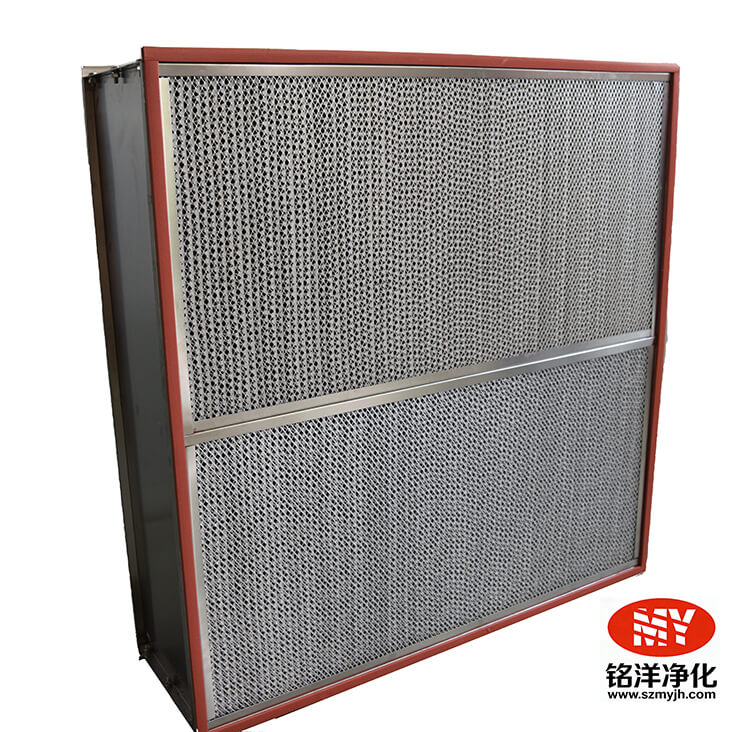
Those in biopharmaceutical purification engineering know that the biggest difference between sterile workshops in pharmaceutical factories and ordinary industrial cleanrooms is the need for routine high-temperature dry heat sterilization and fumigation. Ordinary HEPA filters cannot withstand repeated high-temperature baking, leading to issues like media embrittlement, glue failure, and air leakage, which directly cause excessive microbial and particle levels in the workshop, hindering GMP acceptance. This is whyHigh-temperature HEPA filter for biopharmaceutical plantsis a necessary configuration for all sterile pharmaceutical production lines. Drawing on years of experience in on-site renovation and supporting supply for pharmaceutical factories, let's discussApplication of High-Temperature HEPA Filtersindustry standards and on-site technical requirements.
I. Unique Cleanliness and High-Temperature Operating Conditions in Biopharmaceutical Workshops
According to the new GMP pharmaceutical production standards and GB/T14295 air filter national standard, Class A and B clean areas in pharmaceuticals have strict control over microorganisms and suspended particles. To prevent bacterial growth and residual drug contamination, workshops regularly perform dry heat sterilization at 120°C-180°C, and the entire supply, return, and exhaust filtration system must endure the high-temperature cycle simultaneously.
Ordinary HEPA filters typically withstand only 60°C-80°C. When subjected to high-temperature sterilization, the binder in the filter media volatilizes, and the glass fiber shrinks and deforms, creating invisible pinholes and gaps. Short-term use leads to dust and bacteria leakage, failing to meetGMP Clean Air StandardsThis is also the core reason why pharmaceutical factories must specifically select high-temperature resistant filter media.
2. Core Technical Standards for Pharmaceutical-Grade High-Temperature Resistant HEPA Filters
For Biopharmaceutical ScenariosPharmaceutical Cleanroom HEPA FilterIt is by no means comparable to ordinary high-temperature filter screens, as the industry has clear and strict technical thresholds:
1. Custom temperature resistance rating, adapted to pharmaceutical sterilization processes
The market mainly offers two types: 130°C long-term temperature resistance and 180°C intermittent dry heat sterilization, fully matching the daily sterilization conditions of pharmaceutical factories. The filter media uses binder-free high-purity borosilicate glass fiber, which does not release harmful substances or embrittle and shed particles at high temperatures, preventing secondary contamination and complying with pharmaceutical production safety standards.
2. High-level filtration efficiency, stable cleanliness grade
Sterile areas in pharmaceutical factories are uniformly equipped with H13 and H14 high filtration grades, achieving over 99.95% filtration efficiency for 0.3μm particles, effectively intercepting dust, spores, and microbial particles, ensuring clean environments for critical operations like filling, compounding, and sterile sampling.
3. High-temperature resistant sealing structure prevents air leakage at high temperatures.
Many low-cost high-temperature filters fail at the sealing stage. Professional pharmaceutical-grade filters use stainless steel frames with specialized high-temperature silicone sealant, which does not degrade, flow, or crack after repeated high-temperature baking, completely solving the common problem of frame air leakage under high-temperature conditions, suitable for long-term high-frequency sterilization in pharmaceutical factories.
III. Core Application Scenarios for Pharmaceutical Plants, Precise Selection Based on Working Conditions
Not all pharmaceutical areas require the same high-temperature filter; on-site zoning selection is needed to match actual working conditions.
1. Tunnel sterilization ovens and high-temperature sterilization exhaust systems: Long-term exposure to high-temperature airflow, prioritize 180°C high-temperature models to block drug residue and microbial escape.
2. Sterile filling and formulation workshop circulating air systems: Regular overall dry heat sterilization, 130°C temperature-resistant models suffice for long-term stable operation.
3. Sterile isolators and sampling cabinet exhaust filtration: High sterilization frequency and enclosed spaces, non-standard sizes can be customized as needed.Dry Heat Sterilization HEPA Filter。
Mingyang can provide customized solutions based on the sterilization temperature and cleanroom classification requirements of different pharmaceutical factories.Selection of High-Efficiency Filter Media for High-Temperature Conditionsto avoid over-engineering or under-specification, suitable for renovation and new installation projects in various biopharmaceutical and formulation workshops.
4. Practical Maintenance Points for High-Temperature Filters in Pharmaceutical Plants
High-temperature filters cannot be maintained like ordinary filters. After each dry heat sterilization, the equipment must be allowed to cool naturally before conducting PAO aerosol leak testing to avoid data distortion at high temperatures. Daily replacement is based on system differential pressure; when pressure drop doubles, replace the entire batch promptly to ensure stable GMP cleanliness indicators in the workshop.
Conclusion
The high-temperature sterilization characteristics of biopharmaceutical workshops make it impossible for standard high-efficiency filters to meet production requirements. Compliant selection is essential.High-temperature HEPA filter for biopharmaceutical plantsIt is the key to stable workshop production and smooth GMP audit. Deeply rooted in the purification industry for 18 years,Mingyang PurificationFamiliar with various pharmaceutical workshop conditions, we provide a complete solution for customizing, selecting, and supplying high-temperature filtration equipment.